
October 2, 2026

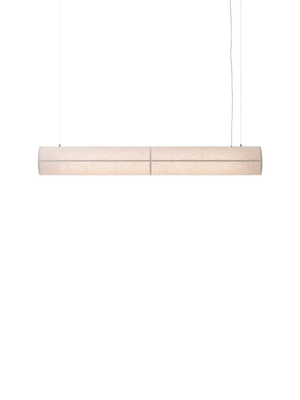
The starting point was the Japanese paper lantern and the way it gives form to light. Its construction is simple yet the effect in a room can be quite profound. We were interested in the relationship between structure and atmosphere. Hashira carries something from that tradition: the idea of a translucent shade stretched around a visible frame, so the light becomes part of the object’s architecture.
Hashira means column or pillar in Japanese. As architects, that felt like a natural reference. A column is one of the most basic ways of defining space. In Hashira, the column isn’t heavy or monumental. It becomes a softer presence. The lamp stands in the room as a luminous structure, with the frame visible through the linen shade.
That was one of the essential questions for us. The Japanese paper lantern is so closely tied to Japan that a direct interpretation could easily feel clichéd. We weren’t interested in simply reproducing the appearance of the lantern. We were interested in how it works and what gives it its lasting quality. A thin surface softens the light while the construction remains visible through it. Hashira keeps that principle but changes the language. The paper becomes linen. The lantern becomes a textile lamp. That shift allowed the reference to stay present without becoming theatrical.
Both traditions often begin with a practical need and try to remove what is unnecessary. The beauty comes from the way an object is made rather than from adding decoration. Hashira belongs to that way of thinking. It has the clarity of a simple architectural form, but the linen gives it warmth. It doesn’t try to look Japanese or Scandinavian in an obvious way. It is more about taking a familiar principle and making it work in another context.

Textile gave us a way to soften the light without hiding the construction. It lets the lamp glow without exposing the light source, which was important for the atmosphere we wanted. It also changes the object when the lamp is switched off. Metal and glass can introduce a harder character into a room. Linen has a different presence. It sits more naturally in a room, and it allowed us to work at a larger scale without
making the lamp feel heavy.
The main consideration was the relationship between the shade and the frame. If the structure became too visible, the lamp would lose its softness. If it became too hidden, Hashira would lose the graphic character that makes it recognisable. The proportions had to do a lot of work. The lamp needed to be reduced, but not anonymous. It had to be calm enough to live with, while still having enough presence to hold a room.
We see Hashira as a lamp that can adapt to the room. In a home, it might bring warmth to a corner or create a softer atmosphere around a table. In a larger interior, it can work in repetition, almost like a rhythm of light. That ability to be both present and understated is important to us. A single lamp can be a point of focus. Several lamps together can begin to shape the experience of a space.


First of all, as something that works well. A lamp has to meet a need, but it should do so in a way that feels natural and generous. It should make the room better without demanding too much attention.
We hope Hashira feels familiar without becoming a direct copy of a Japanese lantern. By using linen rather than paper, the design comes closer to the textile lampshades we know from Western interiors. That shift was important. The lamp should carry the memory of where the idea began, while belonging naturally in a room. If it continues to work as both a source of light and part of the room, it has a better chance of staying relevant over time.
In winter, light becomes more closely tied to how a room feels after dark. It’s not only there to help us see. It affects how we enter a room, how long we want to stay there and how the space feels after dark. Hashira is a soft source of light. It doesn’t try to brighten a room in a hard or functional way. It gives the interior warmth, and in the darker months that kind of light becomes especially important.
We often return to the idea that a design should be reduced until it still has character but no longer carries unnecessary expression. Hashira follows that line of thinking. The form is simple without being neutral. Its expression comes from the relation hip between the frame and the shade, and from the way light moves through that surface. It’s not trying to attract attention through ornament. It is more about creating an object that feels resolved.
The Hashira Collection set the scene for an evening inspired by Japan. Held in Norm
Architects’ studio apartment, the event brought together design conversation
and Japanese tea culture under the warm glow of the Hashira lamps.
A glimpse inside Vesper Milano Palma, where considered details, sculptural forms and soft lighting shape an inviting atmosphere. We sat down with Olja and Mauricio Fuentes Corridan, co-founders of the...
A glimpse inside Vesper Milano Palma, where considered details, sculptural forms and soft lighting shape an inviting atmosphere. We sat down with Olja and Mauricio Fuentes Corridan, co-founders of the...
Join us for our holiday pop-up with longvé on December 18th – perfect for finding those last-minute gifts or indulging in a well-deserved end-of-year treat for yourself. longvé offers diamond...
Join us for our holiday pop-up with longvé on December 18th – perfect for finding those last-minute gifts or indulging in a well-deserved end-of-year treat for yourself. longvé offers diamond...
Step into a moment of calm with Hana, holistic facialist and massage therapist at Audo Residence’s serene space. Begin your experience with a warm cup of house-blend herbal tea and...
Step into a moment of calm with Hana, holistic facialist and massage therapist at Audo Residence’s serene space. Begin your experience with a warm cup of house-blend herbal tea and...


